The FDA has lifted the clinical hold on Aardvark Therapeutics’ Investigational New Drug (IND) application for ARD-101, a potential treatment for hyperphagia in Prader-Willi syndrome (PWS).
Aardvark voluntarily paused dosing in the Phase 3 HERO trial and its open-label extension (OLE) trial in February following reversible electrocardiogram (ECG) changes observed during routine safety monitoring in a separate study involving healthy volunteers. The FDA subsequently placed the program on clinical hold. Following additional safety studies and discussions with the FDA, the hold has now been lifted.
“We are pleased that the FDA has lifted the clinical hold on ARD-101, allowing us to continue advancing our clinical development program,” said Tien Lee, M.D., Founder and Chief Executive Officer of Aardvark. “With strong alignment and collaboration with the FDA, we completed the work necessary to allow for the resumption of clinical studies. People living with PWS and their families continue to face profound unmet need, and we look forward to working with the FDA as we advance ARD-101.”
What the Available Trial Data Showed
On October 23, Aardvark shared exploratory findings from the HERO trial and its open-label extension. Both trials ended early, limiting the conclusions that can be drawn about ARD-101’s effectiveness.
Hyperphagia was measured using the Hyperphagia Questionnaire for Clinical Trials (HQ-CT), a caregiver-reported assessment of food-related behaviors. Lower scores indicate improvement.
Scores improved in both the ARD-101 and placebo groups during HERO, with modestly greater improvement in the ARD-101 group through Week 8. After dosing stopped, the ARD-101 group’s scores returned close to their starting levels, while the placebo group retained more improvement.
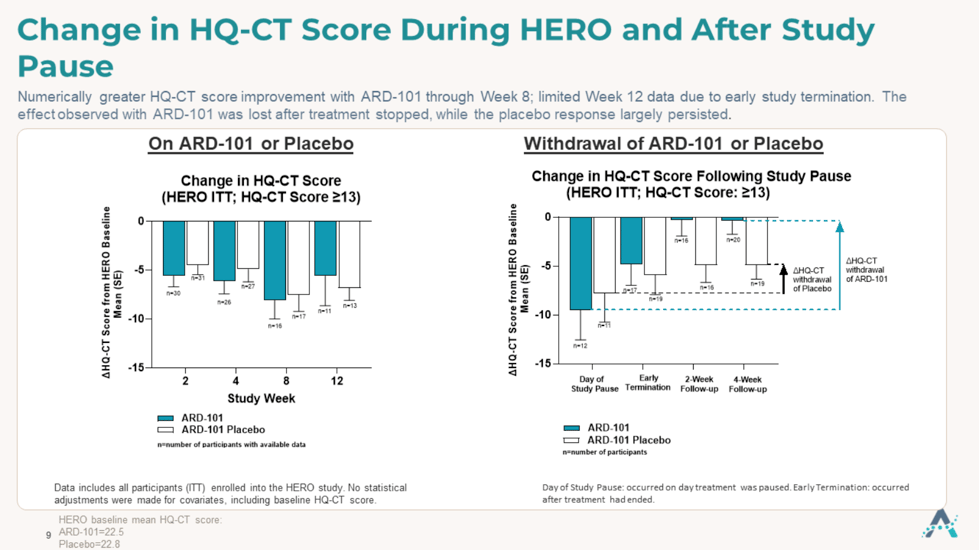
Caregiver-reported hyperphagia scores during the HERO trial and after treatment stopped. Lower scores indicate improvement. Findings are exploratory because the trial ended early. Source: Aardvark Therapeutics, October 23, 2026.
Participants who switched from placebo to ARD-101 in the open-label extension showed additional improvement. Aardvark described the treatment and withdrawal patterns as encouraging signals supporting further study. However, participant numbers were small, particularly at later visits, and these findings do not establish efficacy.
The Need for Additional Treatment Options
During the webcast, Lynne Bird, MD, a clinical geneticist and HERO trial investigator, emphasized the continuing burden of hyperphagia and the need for additional treatment options. Even with treatment advances, food security and supervision remain significant daily responsibilities for families. “We need more things in our tool chest,” she said.
What Happens Next?
With the clinical hold lifted, Aardvark plans to work with the FDA on the design of a new Phase 3 trial. The previous HERO and open-label extension trials have ended. Details about the new trial—including enrollment dates, study locations, age requirements, and whether previous participants can join—have not yet been announced.
FPWR invested in Aardvark in 2021 and again in 2024, helping support its first PWS clinical trial and generate early data. We remain committed to advancing meaningful treatments for people with PWS and will share further updates as the program moves forward.
About ARD-101
ARD-101 is an investigational oral drug being developed for hyperphagia in Prader-Willi syndrome. It is designed to activate bitter taste receptors in the gut, stimulating the release of hormones involved in hunger and satiety signaling. ARD-101 is not FDA-approved.
About Aardvark Therapeutics, Inc.
Aardvark is a clinical-stage biopharmaceutical company developing novel, small-molecule therapeutics designed to suppress hunger for the treatment of Prader-Willi syndrome and metabolic diseases. For more information, visit www.aardvarktherapeutics.com.