At Heidelberg University Hospital in Germany, Dr. Rachel Gilmore and medical student Clara Borlinghaus are working together to advance research in Schaaf-Yang syndrome (SYS), a rare genetic condition linked to changes in the MAGEL2 gene.
Background and Path to SYS Research
Dr. Gilmore is currently in the second year of her FPWR-funded postdoctoral fellowship in the lab of Dr. Christian Schaaf. Prior to this, she completed her PhD at UConn Health in Farmington, Connecticut, where she developed cellular models to study Prader-Willi syndrome (PWS). “One of my main projects investigated snoRNAs—a special and not well-understood type of RNA—and their involvement in PWS,” she explained. Her passion for the field extended beyond the lab: “I loved the PWS & SYS research field and community so much, I moved my life—including my partner and our cat—across the ocean to Germany to continue studying these syndromes.”
Clara Borlinghaus, now in her fifth year of medical school at Heidelberg University, discovered her interest in human genetics early on. “My enthusiasm for the field was sparked in my first year, particularly through lectures by Dr. Schaaf,” she shared. Learning about SYS—and the strong, engaged family community—motivated her to pursue research and begin her medical thesis in this area.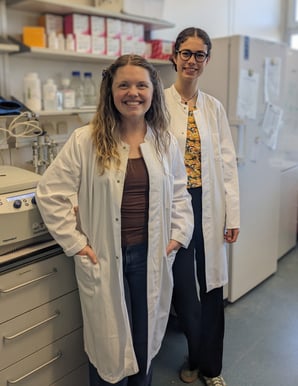
Research Focus: Sleep and Circadian Rhythms in SYS
Together, Gilmore and Borlinghaus are studying sleep disturbances, a common and challenging feature of SYS. “Many individuals with SYS experience difficulties with sleep and disrupted daily rhythms,” Borlinghaus said. “Our research aims to better understand how the body’s internal clock is affected.”
Their work uses a laboratory rat model with a truncated version of the Magel2 protein. By comparing these rats to those with a full-length version, they analyze how gene and protein activity changes over a 24-hour cycle. “While the model doesn’t directly mimic a specific variation found in SYS patients, it is one of the first where the presence of a truncated Magel2 protein was confirmed,” Gilmore noted.
The model also reflects certain characteristics seen in SYS, including reduced weight after birth and altered social behavior, making it a valuable tool for understanding the condition.
“Our goal is to better understand what’s happening in the brain,” they explained, “so we can hopefully identify ways to improve sleep quality and daily routine for individuals with SYS and those who care for them.”
Breakthroughs in Measuring MAGEL2
One of the most exciting developments in their work is progress in measuring the Magel2 protein—something that has historically been very difficult for researchers.
“This has been a notoriously difficult task for researchers all over the world,” Gilmore said. With support from Heidelberg University’s Proteomics Core Facility, they are now close to being able to measure this protein reliably and at scale.
“It will allow us to study how the amount of Magel2 changes over the course of a day,” Borlinghaus added, “and how that can affect overall daily rhythm regulation.” This advancement could significantly deepen understanding of how MAGEL2 functions in SYS.
A Shared Goal: Improving Lives
Both researchers are driven by the long-term impact they hope their work will have on individuals with SYS and their families.
“I hope my continued work on MAGEL2 will help bring clarity to the research community, individuals with SYS, and their families,” Gilmore said. “Understanding MAGEL2 at a molecular level should help inform therapeutic development so these approaches have the best chance of being effective.”
Borlinghaus shares that vision: “Even small progress is important, because it builds the basis for future research and can, over time, contribute to better care for individuals with SYS.”
Motivation from the SYS Community
The SYS and PWS communities play a key role in keeping both researchers motivated.
“The annual FPWR conference is one of my favorite times of the year,” Gilmore shared. “When experiments in the lab are just not working, thinking about the support I have from the SYS community is what helps me pick myself back up and try again.”
Although Borlinghaus has not yet attended, she looks forward to connecting with families and fellow researchers. “I’m motivated by the idea that my work has the potential to help many families,” she said.
How the Community Can Support Research
Gilmore and Borlinghaus emphasize that community support remains essential to advancing research.
As their work continues, Dr. Rachel Gilmore and Clara Borlinghaus are helping to deepen understanding of Schaaf-Yang syndrome—while strengthening the connection between scientific discovery and the community it aims to serve.