
Many parents wonder how to help their child build friendships, understand emotions, and navigate everyday social situations. One powerful—and often overlooked—tool is pretend play.
In this blog, guest contributor Rachel Gordon from the Neurodevelopmental Research Lab at Case Western Reserve University discusses their research on how pretend play can help children with Prader-Willi syndrome build important social and emotional skills.
Why Play Matters
 Play is more than just fun. When children create stories, act out different roles, and imagine what others might be thinking or feeling, they are practicing important social and emotional abilities in a natural and enjoyable way. Furthermore, parent-child play serves as a natural resource for building family relationships, having fun, fostering positive interactions, and supporting these key aspects of your child’s development. Because children with PWS often experience challenges with emotional understanding, flexibility, and social interactions, our team wanted to better understand how adults can most effectively support these moments of imaginative play.
With funding from FPWR, researchers at Case Western University developed and tested the PRETEND (Play-Based Enrichment to Enhance Development) program to help children with PWS strengthen pretend play, creativity, emotional understanding, and social engagement. These skills lay the foundation for the development of social and cognitive skills in children. A recent study examined interactions between children participating in the PRETEND program and the adults supporting them to identify which strategies were most helpful for encouraging imagination, storytelling, and emotional expression.
What Did Researchers Learn?
In the 2026 study by Gordon and colleagues, researchers analyzed multiple PRETEND intervention sessions to better understand how adults can support imagination and emotional expression during play.
One of the clearest findings was that adults do not need to direct a child's play in order to promote learning and skill development. In fact, the most effective approaches involved joining the child's play, following their lead, and helping the story unfold naturally.
Two Powerful Play Strategies: Modeling and Reflecting
Two adult strategies consistently stood out as especially helpful: modeling and reflecting.
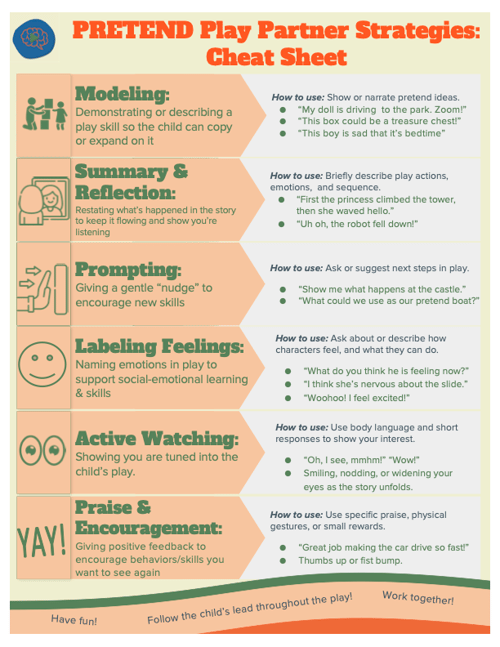
Modeling: Showing New Ideas Through Play
Modeling happens when an adult becomes an active play partner and demonstrates ideas within the story. For example, a parent might pick up a toy figure and say, “My character is looking everywhere for her lost puppy!” By adding ideas to the story, adults provide examples of imaginative play that children can build on.
Reflecting: Helping Children Build Their Own Stories
Reflecting involves describing or summarizing what is already happening in the child’s play. For example, a parent might say, “The doll looks worried because she can’t find her puppy.” Rather than changing the story, reflective comments help children stay engaged and continue developing their own ideas for the story.
The findings from this study suggest that these approaches may be especially helpful for children with PWS because they provide support without taking control of the play. They encourage the child with PWS to lead the play story with the adult acting as a supportive play partner.
When Questions Help—and When They Don't
Questions and prompts were also found to be helpful, particularly when helping children think about emotions. Asking a question such as, “How do you think the doll feels now?” encourages perspective-taking and emotional understanding. Too many questions, however, can interrupt the natural flow of play. Questions may be most helpful when used intentionally and for a specific purpose rather than throughout the play interaction.
Overall, the study suggests that children with PWS may benefit most from a “just right” level of support. Rather than teaching, directing, or correcting, adults can help children with PWS develop these important play and social-emotional skills by modeling ideas, reflecting what is happening in the story, and allowing the child to remain the leader of the play.
What Can Parents Try at Home?
Parents and caregivers can support pretend play by joining the story instead of directing it.
Try:
-
describing what is happening
-
modeling a character’s thoughts or feelings
-
giving your child space to decide what happens next.
Small changes in how parents and other caregivers engage in play can help children with PWS build meaningful opportunities for imagination, emotional expression, and connection, supporting the development of important social, emotional, and cognitive skills.
Strategies for Adult Play Partners
The PRETEND team emphasizes that different children need different levels of support. Consider your child's current skills and adjust your involvement accordingly.
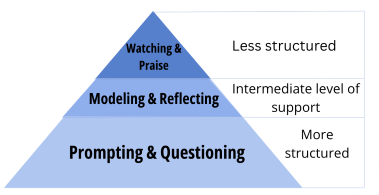
Less Support Needed
- Follow the child's lead
- Reflect and describe what is happening
- Allow the child to drive the story
More Support Needed
- Model new ideas or story elements
- Introduce emotions and perspectives
- Provide gentle prompts to keep the story moving
The goal is not to take over the play, but to provide enough support to help the child stay engaged and expand their imagination.
Participate in Ongoing PWS Play and Creativity Research
The Neurodevelopmental Research Lab is currently recruiting participants for two virtual studies focused on play, social cognition, and social-emotional development in individuals with PWS.
Bringing PRETEND To You Study
The Neurodevelopment Research Lab has spent several years developing and refining the PRETEND intervention, a play-based program that has shown promise for improving play and related social-emotional skills in children with PWS. We are currently seeking adults and providers interested in learning to deliver the PRETEND Program to children with PWS ages 3–7 years, helping expand access to this intervention for families.
Assessing Creativity & Play in PWS Study
This study aims to better understand social cognition in individuals with PWS ages 8–20 years across different stages of development. Participation includes parent surveys and a virtual assessment visit.
To learn more about either study, please contact the Neurodevelopment Research Lab
Email: neurodevelopmentresearchlab@gmail.com
Phone: 216-368-0112.
Meet the PRETEND Team at the FPWR Family Conference
Members of the PRETEND team from the Neurodevelopmental Research Lab will be sharing strategies for supporting play and social-emotional development in children with PWS during an in-person workshop at the FPWR Family Conference in October 2026 in Philly.
We hope to see you there!
Publication Information
Model, Reflect, Describe: Analysis of Critical Intervention Strategies Within a Pretend Play Intervention for Children with Prader-Willi Syndrome
Authors: Rachel A. Gordon, Sandra W. Russ & Anastasia Dimitropoulos
Published: February 2026 in Advances in Neurodevelopmental Disorders
Open Access Link: https://psycnet.apa.org/doi/10.1007/s41252-026-00478-0
