When should a child with Prader-Willi syndrome be screened for scoliosis? Can braces help with walking? Does hip dysplasia always require treatment? And what should families know before spine surgery?
At the 2026 FPWR conference, pediatric orthopedic surgeon Dr. Harold Van Bosse addressed these questions, drawing on more than 25 years of experience caring for individuals with PWS.
Dr. Harold Van Bosse's central message: orthopedic care needs to account for the specific ways PWS affects muscle tone, movement, bone health, and growth. An approach that works for another condition may need to be adapted for someone with PWS.
Watch his full presentation below, or read on for key takeaways.
Download the full video transcript
Supporting movement starts early
Low muscle tone, or hypotonia, affects much more than when a child learns to walk. It can influence head and trunk control, balance, foot position, and the effort needed to move.
Dr. Van Bosse emphasized early physical and occupational therapy, along with feeding support when needed. He encouraged active play that helps children develop strength, including supervised tummy time while awake, reaching, rolling, and crawling.
For children who are not yet walking around 16–18 months, he described considering ankle-foot orthoses, or AFOs, to provide a more stable foundation. In his practice, solid rather than hinged AFOs can help address the tendency to collapse through the ankles.
The goal is to help children get moving, explore their environment, and build strength. The specific support should be selected with the child’s therapists, orthotist, and medical team.
Flat feet can affect walking efficiency
Flat feet are common in PWS, but Dr. Van Bosse explained that the issue is more than a low arch. The heel and front of the foot may shift out of alignment, making it harder to balance and push off while walking.
He discussed different orthotic options and explained his preference for a UCBL-style orthosis in some patients. This device supports the heel and helps align the front of the foot. His emphasis was on what the orthotic actually does for the individual’s foot position and movement.
Walking challenges can continue into adulthood. He described how calf weakness, reduced push-off, and balance difficulties can make walking less efficient. Strengthening and balance activities remain important as people with PWS grow older.
Bone health deserves attention throughout life
Dr. Van Bosse reviewed research showing that low bone mineral density is an important concern in PWS, particularly in adolescence and adulthood.
He discussed several factors families can review with their care team:
- Regular physical activity.
- Adequate calcium and vitamin D.
- Growth hormone treatment and its role at different ages.
- Evaluation of sex hormone deficiencies during adolescence.
- Bone density testing when appropriate.
He emphasized that growth hormone does not address every aspect of bone health. Endocrinology follow-up remains important as needs change over time.
Another practical point: an injury may be more significant than a person’s pain response suggests. Dr. Van Bosse described individuals with PWS continuing to walk despite a fracture. A new limp, reluctance to use an arm, or a change in movement after a fall deserves medical attention—even without a strong complaint of pain.
Hip dysplasia does not always follow the usual course
Hip dysplasia means the hip socket has not developed its usual shape or coverage around the ball of the joint. It is different from a dislocated hip.
Dr. Van Bosse explained that some children with PWS show substantial improvement in hip development over time, including beyond the age when clinicians typically expect that improvement in other children.
He shared examples of hips that initially appeared concerning but gradually remodeled as the children grew. That experience informs his preference for careful observation in selected cases.
However, he also described situations requiring intervention, particularly when the ball begins moving out of the socket, called subluxation.
The takeaway is that hip findings need to be interpreted in the context of PWS. His discussion of observation reflects his clinical approach; decisions about imaging, bracing, or surgery depend on the individual child’s examination and findings.
Scoliosis can be difficult to spot
One of the presentation’s strongest messages was that a significant spinal curve may not be obvious from a child’s appearance.
Dr. Van Bosse showed examples of children whose X-rays revealed much larger curves than an observer might expect. He explained that young children with PWS may not show the same visible signs clinicians look for in other forms of scoliosis.
He highlighted two periods that deserve particular attention: early childhood and adolescence.
In his practice, screening spine X-rays generally begin once a child can sit well independently, often around one year of age. Follow-up depends on the initial findings, with closer monitoring when a curve is present and renewed attention during adolescent growth.
He also discussed avoiding prolonged, unsupported upright sitting before a baby has the trunk control to maintain that position. He described using a reclined feeding seat and allowing children to develop independent sitting skills. Families can ask their therapy team to demonstrate positioning that supports both feeding and movement.
Casting and bracing have different goals
Dr. Van Bosse distinguished between two approaches families often hear about:
Casting can reduce a curve in a young child. A series of casts is applied under anesthesia and changed as the child grows. Depending on the response, casting may substantially improve the curve, allow a transition to bracing, or help delay surgery while the child grows.
Bracing generally aims to limit progression. He described his approach to nighttime and daytime braces, with the design and schedule tailored to the curve.
Neither approach guarantees that surgery will be avoided. He shared examples of children who responded well and others whose curves progressed despite treatment.
He also emphasized that successful early treatment does not eliminate the need for later monitoring. A curve can return or worsen during adolescence. Even when surgery is eventually needed, earlier treatment may have provided valuable years of growth.
Spine surgery requires planning specific to PWS
Surgical decisions involve more than the size of a curve. Dr. Van Bosse discussed growth, breathing, bone quality, readiness, and the spine’s alignment when viewed from the side.
He explained that people with PWS may have a different comfortable head and trunk position. Surgical planning needs to account for that posture.
He also highlighted considerations families can discuss with the surgical team:
- Anesthesia planning and familiarity with PWS.
- Sleep apnea and respiratory support.
- Constipation and the return of bowel function after surgery.
- Gradual progression of food after surgery.
- Protecting the incision from skin picking or rubbing.
- Monitoring movement and neurologic function during recovery.
He described protective dressings and postoperative bracing used in his practice to help keep incisions safe.
Scoliosis does not automatically mean stopping growth hormone
Dr. Van Bosse addressed a concern that has circulated for years: whether growth hormone causes or worsens scoliosis.
He explained that the evidence reviewed in his presentation does not support routinely stopping growth hormone simply because a child has scoliosis. He emphasized its benefits for muscle development and metabolism.
Families should coordinate decisions with their endocrinologist and orthopedic team rather than assume a spinal curve requires treatment to stop.
Keep asking questions as your child grows
Orthopedic care in PWS continues beyond early milestones. Foot support, spine monitoring, bone health, and treatment needs can change through adolescence and adulthood.
Dr. Van Bosse’s presentation offers families a starting point for those conversations—and a reminder that understanding PWS is an essential part of understanding the orthopedic problem.
Find more support for orthopedic care
Looking for more information about scoliosis, bracing, hip development, or bone health? Explore more resources to help you prepare for appointments and navigate orthopedic care.
Explore Orthopedic Care in PWS →
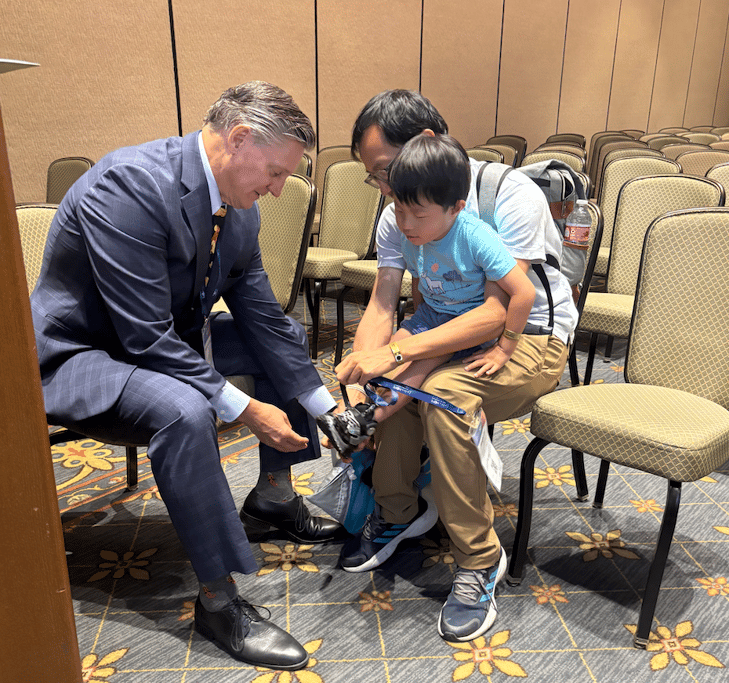
Dr. Harold Van Bosse connects with a family following his presentation on orthopedic care in PWS.