Scoliosis is a common orthopedic complication in Prader-Willi syndrome (PWS), affecting the majority of individuals at some point during infancy, childhood, or adolescence. Scoliosis in PWS is not the same as the more familiar forms of scoliosis. Differences in muscle tone, growth, posture, and bone health among individuals with PWS can influence how curves develop, progress, and should be treated.
This article reviews the common types of spinal curves seen in PWS, when and how scoliosis should be monitored, current approaches to treatment—including physical therapy, casting, bracing, and surgery—and important considerations families should understand when making care decisions.
What Causes Scoliosis in PWS?
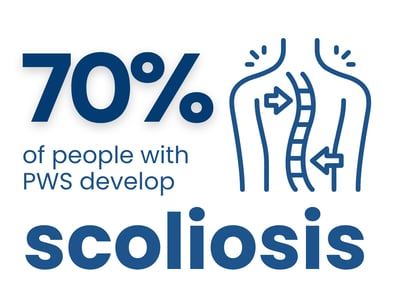 Scoliosis affects the majority of people with PWS, up to 70% of individuals over their lifetime.
Unlike idiopathic scoliosis, which has no known cause, scoliosis in Prader-Willi syndrome is linked to clear underlying drivers and behaves differently as a result.
Low muscle tone (hypotonia), differences in bone strength, and delayed motor development all play a role. The spine, without strong muscular support, is more vulnerable to developing curvature.
These underlying differences also mean that curves in PWS don’t follow the same patterns as idiopathic scoliosis, and often require a different approach to monitoring and treatment.
What Types of Spinal Curves Occur in PWS?
Early on, many children develop a C-shaped curve, often driven by hypotonia and asymmetrical posture. As strength improves, the body may compensate, creating a second curve and resulting in an S-shaped spine, so that the child is better balanced with the head centered over the pelvis.
Over time, another important feature often emerges: kyphosis, or forward rounding of the spine. Many individuals with PWS develop kyphoscoliosis, a combination of sideways and forward curvature, which adds complexity to both treatment and surgical planning. Sometimes the kyphosis is actually the dominant finding.
These curve differences influence not just how scoliosis progresses, but also how it should be treated.
When and How Should Scoliosis Be Monitored?
Scoliosis and kyphosis are measured in degrees of curvature. When speaking of scoliosis, curves under 20° to 25° can spontaneously resolve, so these should be closely monitored with radiographs every 3-6 months.
Treatment starts when curves show progression or pass 25°. The goal is to keep the curve below 40° by the time the child is mature. Curves under 40° rarely progress in adulthood, but curves over 50° nearly always continue to worsen in adulthood, and are therefore indicated for surgical treatment.
 The risk of developing scoliosis in Prader-Willi syndrome is high, estimated at 70% or more before skeletal maturity. But that risk is not evenly distributed across childhood.
There are two key periods when scoliosis is most likely to emerge: early childhood and adolescence. Studies suggest that about 23% of children develop a curve before age four, though registry data indicate this number may be higher, with up to 35% of families reporting scoliosis in early childhood. A second wave occurs during growth spurts, with roughly 45% of individuals developing scoliosis during adolescence.
One of the challenges with scoliosis in PWS is that it can be difficult to detect visually. Compared to typical scoliosis, there is often less spinal rotation and less obvious rib asymmetry. That means curves can progress quietly.
Because of this, imaging plays a critical role in early detection. Experts recommend beginning routine spine X-rays once a child can sit independently, followed by ongoing monitoring throughout growth. In younger children, these are typically seated X-rays. As strength and mobility improve, they transition to standing X-rays, which provide a more accurate picture of how the spine aligns under gravity.
In early childhood—particularly through age four—imaging is often performed annually, with frequency adjusted over time based on age, growth, and whether a curve is present or progressing.
Waiting for visible signs can mean missing the window where intervention is most effective.
What Are the Treatment Options for Scoliosis in PWS?
Treatment for scoliosis in PWS isn’t a single step. It evolves over time, guided by a child’s age, growth, and the behavior of the curve.
Physical Therapy
Management often begins very early, with a focus on physical therapy. Because low muscle tone plays such a central role in PWS, building core strength and supporting proper positioning can influence how the spine develops. Tummy time activities should be encouraged many times a day, as an excellent way to strengthen back extension muscles.
One important consideration is timing. Children should not be placed in unsupported sitting until they are able to move into that position independently. Sitting too early, without adequate strength, can lead to a slouched posture that contributes to curve formation. As strength improves, therapy shifts toward activities like quadruped positioning and crawling, helping build the stability needed for standing and walking.
Casting
For younger children (from sitting age to about 5 years of age) who develop curves, serial spinal casting can be one of the most effective interventions. Unlike bracing, which is designed to hold a curve in place, casting can actively guide the spine toward correction when started early.
Curves around 25° are often the point at which treatment becomes most effective, particularly in younger children. The process does require commitment, with casts typically changed at regular intervals:
- Every 2 months for children under age 2
- Every 3 months for children ages 2–3
- Every 4 months for children over age 3
In some cases, casting can significantly reduce the curve and limit the need for more invasive treatments later.
Bracing
As children grow older, bracing becomes the more common approach. It is typically recommended for curves greater than 20–25° in children who are too old for casting.
At this stage, the goal shifts from correction to control—preventing further progression during periods of growth. In larger or progressing curves, bracing may also help delay the need for surgery until a child is older. For smaller curves (less than 30°), a nighttime-only “bending” brace can be used. If the curve progresses past 30°, a daytime brace is added, for a total of 22 hours per day.
While wearing a brace can be challenging, particularly for individuals with PWS, consistent use can make a meaningful difference in slowing curve progression.
Surgery
Despite best efforts, some curves continue to progress. Surgery is typically considered when curves approach or exceed 50 degrees. At this point, larger curves are far more likely to worsen over time, even after growth has stopped.
But in PWS, surgery is never a simple decision. There is a high complication rate: infections as a result of skin picking, anesthesia complications, hardware issues, and slow GI are all challenges to be aware of and be prepared for.
The timing, type of procedure, and goals of correction all need to be carefully tailored. Younger children with severe curves may benefit from expandable rods that allow continued growth while stabilizing the spine. For adolescents, spinal fusion is often delayed as long as possible to preserve growth.
What are the Risks of Scoliosis Surgery in PWS?
Perhaps the most important shift in thinking is this: children with PWS are not typical scoliosis patients. Their underlying condition changes how surgery must be approached.
Factors like low bone density, altered posture, respiratory vulnerability, and behavioral differences all influence both the procedure and recovery. Even surgical alignment must be approached differently. Correcting the spine to a “normal” alignment can actually lead to new complications, particularly related to kyphosis.
There are also risks that families should understand clearly:
- Hardware complications, including screw pull-out from bone, failure or rod breakage
- Infection and wound healing challenges, most commonly related to skin picking
- Junctional kyphosis (new curvature near the surgical site)
- Respiratory and gastrointestinal complications during recovery
These risks are real, but they are not a reason to avoid surgery when it is needed. Instead, they underscore the importance of working with experienced teams who understand PWS and plan accordingly.
If you are beginning to prepare for surgery, review this Primer on Scoliosis Surgery for Prader-Willi Syndrome written by Dr. Harold van Bosse, MD. This paper includes important details on special considerations for individuals with PWS undergoing scoliosis surgery, including respiratory and gastrointestinal concerns, anesthesia and pain management, skin picking and wound healing, bone density, surgical alignment, and post-operative recovery planning.
Read more about preparing for Spinal Fusion surgery in our blog: Spinal Fusion Surgery in Prader-Willi Syndrome: Preparing for Surgery and Recovery.
Does Growth Hormone Affect Scoliosis in PWS?
One concern that often arises is whether growth hormone therapy contributes to scoliosis progression.
Studies show that growth hormone does not increase the risk or severity of scoliosis in individuals with PWS. In fact, it provides important benefits, including improved muscle mass, bone density, and overall health.
For most children, scoliosis should not be a reason to stop treatment.
Key Takeaways for Families
Scoliosis in PWS can feel overwhelming, especially when decisions about bracing or surgery come into play. But the trajectory is not fixed. Early monitoring, timely intervention, and care from experienced providers can significantly change outcomes. The most important step is staying ahead of the curve—literally.
Key points to remember:
- Start screening early and monitor consistently
- Don’t rely on visual signs alone
- Early intervention can change the course of a curve
- Treatment decisions should reflect the unique needs of PWS
- Work with providers experienced in PWS whenever possible
Additional Resources on Scoliosis in PWS
For families looking to learn more, we have the following resources:
- Clinical Observations and Treatment Approaches for Scoliosis in Prader-Willi Syndrome
- A Primer on Scoliosis Surgery for Prader-Willi Syndrome
- Study Confirms Growth Hormone for PWS Does Not Worsen Scoliosis
- Orthopedic Challenges and Treatments in PWS (2022 Conference Video)
- PWS Registry Data: Scoliosis in PWS
These resources provide deeper insight into treatment approaches, clinical research, and real-world care strategies.