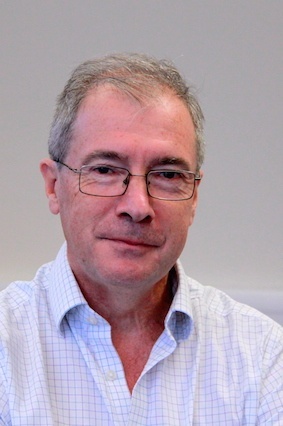
 There has been much interest in the Prader-Willi syndrome (PWS) community regarding vagus nerve stimulation, a novel approach to treat challenging PWS-related behaviors. Research into vagus nerve stimulation (VNS) firstwhich is being led by Dr. Tony Holland and supported by FPWR. In fact, Dr. Holland, a psychiatrist, has spent his career as a pioneer in PWS research and advocate for the PWS community. We were fortunate to chat with Dr. Holland and learn about both his recent efforts in PWS research as well as his background and long-term perspective on PWS.
Intellectual Disability Focus Starts With Residency
Dr. Holland traces his interest in medicine back to his early teens. He feels that he and his twin brother, who also went into medicine, were both were likely influenced by their father, who was in the insurance profession but always wanted to be a doctor. Dr. Holland studied general medicine, cardiology, and neurology in London in the UK, before specializing in psychiatry at the Institute of Psychiatry and Maudsley Hospital. During his residency, Dr. Holland's further specialization in the study of and care for individuals with intellectual disability came about somewhat by chance, when he received a placement in a facility for children with intellectual disabilities. During this period, he became fascinated by the mixture of biological and sociological challenges faced by kids with intellectual disability, and this interest determined the future course of his career. He served as a clinician and lecturer at the Institute of Psychiatry and Maudsley Hospital, before moving to the University of Cambridge in 1992 as a University Lecturer in Developmental Psychiatry.
Since 2002, Dr. Holland has held the positions of Professor, Health Foundation Chair in Learning Disabilities, and Head of the Cambridge Intellectual and Developmental Disabilities Research Group (CIDDRG) in the Department of Psychiatry. Members of the CIDDRG pursue interdisciplinary research intended to guide the treatment and support for those with intellectual disabilities, including the development of better disability-related legislation. In 2015, Dr. Holland reached the mandatory retirement age and stopped his local clinical work, still maintaining an active career in research and advocacy for those with intellectual disabilities. He has received numerous honors for his work, including being awarded a Commander of the Order of the British Empire (CBE) in 2015 for his "services to psychiatry."
Down Syndrome, Alzheimer's, and PWS
Dr. Holland has enjoyed an extremely distinguished career in the study of intellectual disability, focusing on both the connection between Down Syndrome (DS) and Alzheimer's disease, and the hyperphagia, mental health and behavior problems associated with PWS. Indeed, individuals with DS have a high risk for Alzheimer's (perhaps not surprising given that one of the genes linked with Alzheimer's is found on chromosome 21, whose trisomy gives rise to DS), with approximately 50% of the DS population showing signs of dementia in their 50s. Dr. Holland has considered this question from many different angles, including charting the prevalence of Alzheimer's as a function of age in the DS population, using brain imaging to study the specific structure and function of brains of those with DS as a function of age, analyzing the expression of specific genes, and investigating other biomarkers such as hormone levels, retina thickness, and behavior patterns. Given the high rate of Alzheimer's in the DS population, developing effective treatments for Alzheimer's could have a huge impact on this community.
Dr. Holland's pioneering research on PWS extends over 25 years, covering many key aspects of the disorder including both hyperphagia and mental illness. He first encountered PWS in the early 1990s while studying appetite disorders. One of his important early PWS-related studies consisted of the so-called "sandwich study," in which he demonstrated that people with PWS needed to consume significantly more food calories to reach the same level of satiety as aged-matched control participants, and furthermore had feelings of hunger resume soon after food was removed. This highly-cited study systematically demonstrated biological differences (e.g., blood levels of key eating-related hormones like cholecystokinin) in the response to food intake in individuals with PWS. In detail, the results showed that participants with PWS were able to feel satiated, but that the satiation mechanism was much less sensitive than in the control participants.
PWS As Genetic Model Of Starvation, Not Obesity
A decade later, informed by his ongoing PWS research on obesity and the early emerging results on the genetics of PWS, Dr. Holland proposed a conceptual picture for PWS as a genetic model of starvation rather than one of obesity — the fact that individuals with PWS commonly end up obese is a result of access to food. Another of Dr. Holland's significant contributions has been to demonstrate a strong link between the prevalence of psychosis and the uniparental disomy (UPD) form of PWS, which occurs when there are two maternal copies of chromosome 15. Characterizing the prevalence of psychosis in PWS, and the genetic and environmental factors that cause psychotic symptoms, is a key component for developing effective treatments.
Using Vagus Nerve Stimulation For PWS Behavior Problems
Dr. Holland first studied vagus nerve stimulation (VNS) after learning from a colleague about its use to reduce seizures in people with epilepsy—during which some participants also experienced weight loss. Because the vagus nerve plays an important role in communication between the gut and brain, VNS seemed like an intriguing avenue to explore in PWS.
In an initial pilot study of three people with PWS, VNS did not lead to measurable changes in appetite or weight. However, it had a striking effect on behavior, with two of the three participants reporting life-changing reductions in behavior outbursts. Improvements in quality of life included the ability to hold a part-time job, get married, and live independently.
These early results led to further investigation. With support from FPWR, Dr. Holland has now completed two VNS clinical trials in PWS, continuing to study whether this approach can reduce behavior outbursts and improve quality of life. Building on what these studies have shown, FPWR is now sponsoring a third, large-scale VNS trial to further evaluate this approach for people with PWS.
Dr. Holland's positive impact on the PWS community extends far beyond his research and clinical work. For example, he has played an active role in influencing disability legislation in the UK, serving as an advisor to parliament during the enactment of the Mental Capacity Act in 2005. This law provides a framework for making decisions for adults who are unable to act on their own behalf due to intellectual disability or other reasons, and impacts the services received by individuals with intellectual disabilities. Dr. Holland is the current president of the International PWS Organization and has served on its scientific board since 2014. He also helped organize the PWS mental health research strategy workshop sponsored by FPWR in 2015. More locally, he has been the psychiatric advisor to the UK PWS Association for many years and is now its Patron. Dr. Holland's achievements in research, clinical work, and legal advocacy have made a difference in the lives of countless individuals with PWS.