In January 2008, The Dallas Morning News published an article titled “Parents Seek Answers.” At the center of the story was Kathryn McGhee, a mother navigating the daily realities of Prader-Willi syndrome while also helping shape a growing research movement that would become the Foundation for Prader-Willi Research.
The article captured a moment in time when answers were scarce, and determination was everything. 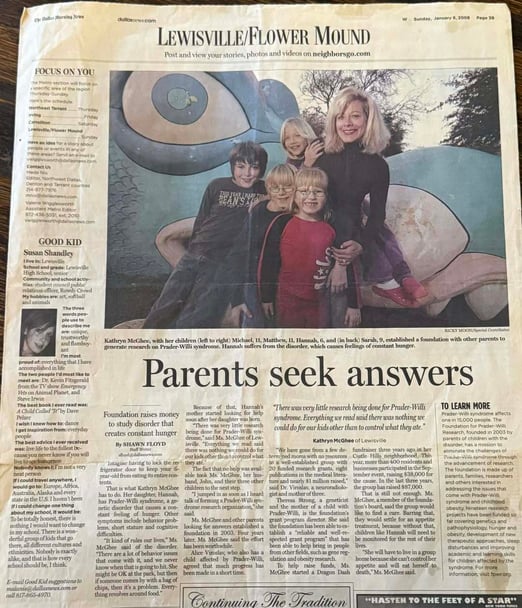
“Imagine having to lock the refrigerator door to keep your six-year-old from eating its entire contents.”
For Kathryn, that was daily life. Her daughter Hannah was diagnosed with Prader-Willi syndrome, a rare genetic condition marked by insatiable hunger, behavioral challenges, short stature, and cognitive difficulties.
“It kind of rules our lives,” Kathryn shared in the article. “Everything revolves around food.”
A peaceful afternoon at the park could quickly unravel if someone walked by with a bag of chips. Managing hunger was not just part of the day. It shaped every decision.
When the Answer Was “There Is Nothing We Can Do”
In 2008, families searching for help were often met with a devastating truth. There was very little research focused on Prader-Willi syndrome, and few paths forward for families seeking answers.
“Everything we read said there was nothing we could do for our kids other than control what they ate.”
That absence of options pushed parents like Kathryn toward action.
Rather than accept a future defined only by management and monitoring, she became involved early in FPWR’s work to change the research landscape for PWS. What began as urgency grew into long-term leadership.
Turning Personal Urgency Into Lasting Impact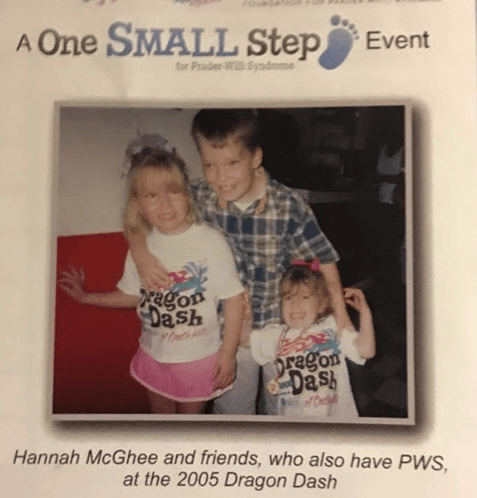
What the article captures, and what time has made even clearer, is Kathryn’s instinct to lead.
Over the years, Kat has served on FPWR’s Board of Directors and hosted countless fundraisers, showing up again and again to keep research moving forward. She raises both dollars and awareness, connects families and advocates, participates in research, and openly shares Hannah’s clinical trial experiences to help others navigate their own paths with more confidence. She hosts an annual May fundraising event, HopeFULL, and participates in FPWR’s Harvesting Hope distance challenge each fall, getting Hannah excited to get out and walk while supporting PWS research.
Long before today’s clinical trials, validated endpoints, and industry partnerships, parents like Kathryn were building momentum from the ground up.
By the time the 2008 article was published, FPWR had already made meaningful progress:
- Multiple funded research grants
- Publications emerging in the medical literature
- Nearly $1 million raised, almost entirely by families
As Dr. Alice Viroslav, a physician and PWS parent, and one of FPWR's co-founders, noted in the article:
“We have gone from a few determined moms with no resources to a well-established group funding meaningful research.”
Building a Research Program That Would Last
Even in its early years, FPWR was focused on rigor and credibility.
Theresa Strong, PhD, a geneticist and mother of a child with PWS, served as the foundation’s early grant program director. She described how FPWR established a reliable and well-respected grant program and brought in experts from outside the PWS space, including gene regulation and obesity research.
Today, Dr. Strong serves as FPWR’s Director of Research Programs, continuing to lead the strategic and high-impact research efforts that families first fought to establish more than two decades ago.
Reading this article now, what stands out is not just how much has changed. It is how much continuity exists. Parent leaders and scientists who helped build FPWR in its earliest days are still guiding the organization forward.
Why it Matters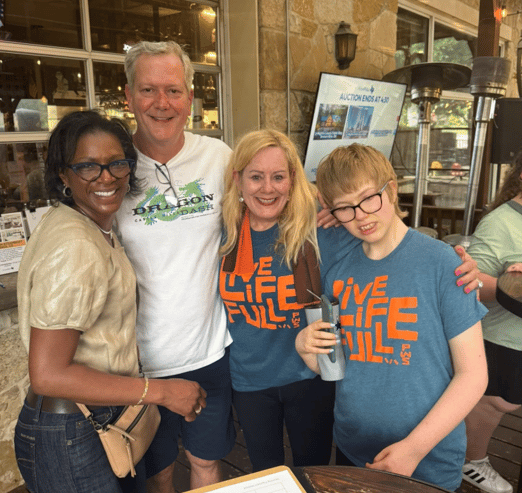
In 2008:
- Appetite treatments did not exist
- Lifelong monitoring was the standard
- Independence felt out of reach for many individuals with PWS
Today, because people like Kathryn refused to accept that future:
- Multiple clinical trials are actively enrolling
- Treatments targeting hunger, anxiety, and behavior are advancing
- Research spans genetics, metabolism, sleep, and precision medicine
This progress is possible because parents organized, fundraised, advocated, and stayed committed for the long haul.
Still Leading the Way
More than twenty years after Hannah’s diagnosis, Kathryn McGhee remains a steady force in the PWS community. Her focus has always been the same. Build a better future for individuals with PWS.
As Kathryn has said:
“I believe that with treatments, our loved ones with PWS can live life FULL.”
That belief, paired with action, is why a look back at this 2008 article is important.
It is also why Kathryn plans to bring HopeFULL back on Sunday, May 17, continuing a legacy of parent leadership that has already helped change the trajectory of PWS research.