Families affected by Prader-Willi syndrome (PWS) often have questions about their child’s development and what they can expect throughout their child’s journey. While every individual with PWS follows their own unique path, data collected through the Global PWS Registry helps provide a better understanding of experiences across the PWS community.
When Are Children with PWS Crawling and Walking?
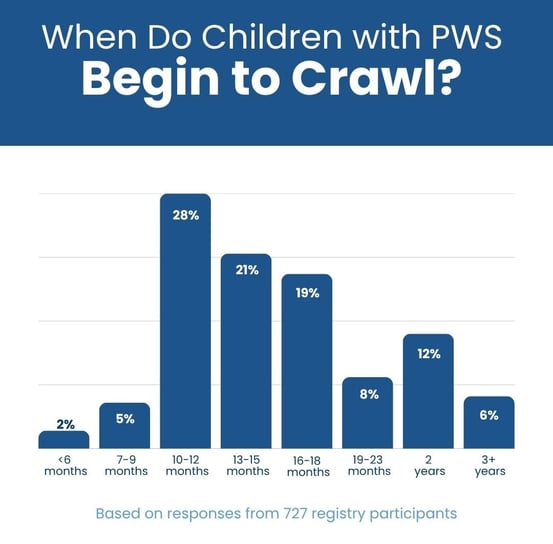
Early motor milestones, including crawling and walking, can be influenced by hypotonia, a hallmark feature of PWS. Registry data provide insight into the wide range of ages when individuals with PWS reach these important milestones. Among 727 individuals with PWS who reported their crawling age, most individuals began crawling after 10 months of age, with the largest group beginning between 10–12 months. Overall, 75% of individuals reported crawling by 18 months and 88% by 2 years.
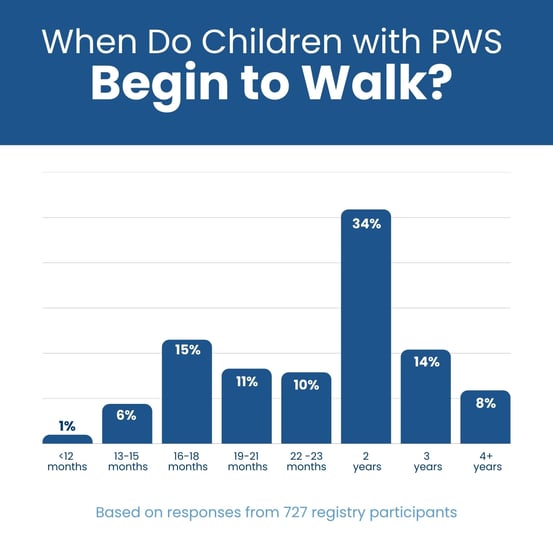
Walking is another important developmental milestone that varies widely among individuals with PWS. Data from 753 individuals with PWS shows that 43% of children begin walking by age 2 and 77% are walking by age 3.
What is the Typical Education Level of a Person with PWS?
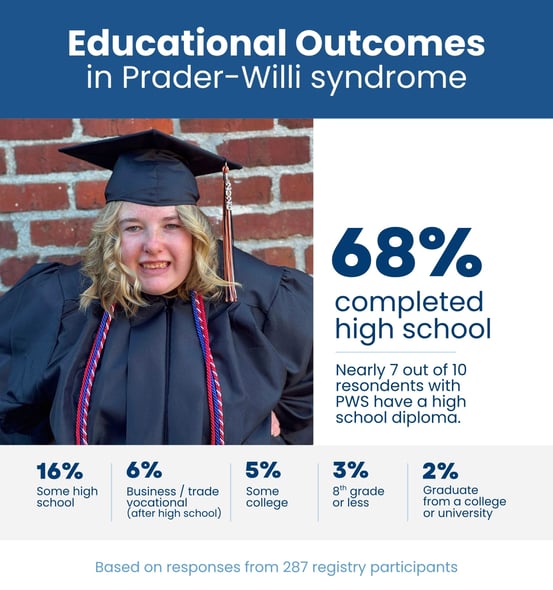
Individuals with PWS have diverse abilities, strengths, and educational experiences. Registry data provides insight into the highest level of education achieved among participants who completed this survey. Among 287 individuals with PWS who reported their highest level of education, high school completion was the most commonly reported outcome. Educational experiences varied, with individuals pursuing a range of paths including vocational training, college coursework, and college degrees.
How Does Global PWS Registry Data Advance PWS Research?
The Global PWS Registry is made possible through the participation of individuals and families who share their experiences. This data helps researchers better understand the natural history of PWS, identify important trends, and support future research aimed at improving care and outcomes.
By contributing information to the Registry, families play an important role in building knowledge about PWS and advancing research for future generations.
Have you completed your Global PWS Registry surveys? Log in today to update your information and help advance PWS research.